
Across the GCC, AI has stopped operating as a separate innovation track. In the organizations producing measurable outcomes, AI functions as the intelligence layer that amplifies every stage of the innovation cycle — the way problems get sensed, solutions get shaped, deployments get scaled, and outcomes get sustained. The strategic question for innovation leadership has shifted from whether to deploy AI to how to design the intelligence layer that connects the entire innovation system.
SERIES CONTEXT
This article closes the NewMetrics Innovation Series, building on the anchor piece: ‘Innovation Labs in GCC: Bridging the Public-Private Divide in a $Trillion Transformation Era.’ The seven earlier articles described the methodology, the spaces, the experience signals, the sustainability lens, the sector use cases, the capability layer, and the tool stack. This article addresses how AI amplifies each of those dimensions — operating as the intelligence layer that connects the entire innovation system into a coherent operating architecture.
The GCC has reached a strategic inflection point on artificial intelligence. Saudi Arabia’s National Strategy for Data and AI targets AI to contribute 12% to national GDP by 2030, with data center investment anticipated to reach USD 15 billion and computing capacity expanded to 1,300 megawatts by the end of the decade (Saudi Data and Artificial Intelligence Authority, 2024). The UAE’s Artificial Intelligence Strategy 2031 targets AED 335 billion — approximately USD 96 billion — in economic contribution by 2031 (UAE AI Office, 2024). Project Transcendence — Saudi Arabia’s USD 100 billion drive to accelerate AI and advanced technology adoption — and Stargate UAE, the 5-gigawatt AI data center under development in Abu Dhabi anchored by G42 with OpenAI, Nvidia, Oracle, and Cisco, are creating the sovereign infrastructure base on which the next generation of AI-accelerated innovation will operate (Government of Saudi Arabia, 2024; G42, 2026). Combined GCC AI infrastructure investment commitments are projected to exceed USD 100 billion by 2030, supported by more than USD 3 trillion in regional sovereign wealth (El Hinnawi, 2026).
For innovation programs across the region, this environment has produced a strategic reframing. AI now operates as the intelligence layer that amplifies every stage of the innovation cycle rather than as a separate track that runs in parallel with customer experience, sustainability, sector modernization, and capability building. The seven prior articles in this series described the methodology, spaces, signals, sustainability lens, sector applications, capability, and tool stack that together constitute the NewMetrics approach to GCC innovation. This article addresses how AI amplifies each of those dimensions — operating as the intelligence layer that connects the entire innovation system into a coherent operating architecture.
The organizations generating measurable value from AI-accelerated innovation share a common orientation. They treat AI as an accelerant of the 4S cycle described throughout this series — Sense, Shape, Scale, Sustain — rather than as a standalone category of technology deployment. They invest in the underlying data, governance, and capability foundations that make AI amplification durable. They ground each AI use case in a defined business, customer, sustainability, or citizen outcome. And they design their intelligence layer to compound across the innovation cycle, feeding what is learned in Sustain back into the next Sense stage as continuous organizational intelligence rather than as episodic analytics.

AI As Amplifier Of The Innovation System
The prior articles in this series described innovation as a system rather than as a category of activity. Innovation methodology, spaces, signals, sustainability, sector applications, capability, and tools together constitute the operating architecture of that system. AI enters this system as an amplifier — a capability that increases the speed at which the system operates, the scope at which it can be deployed, and the nature of what the system can do. The value that AI generates is therefore proportional to the maturity of the system it is amplifying. Applied to a mature innovation system with strong methodology, capable people, and well-designed tools, AI produces compounding returns across the innovation cycle. Applied to a system without those foundations, AI produces isolated demonstrations that generate limited durable value.
This positioning has practical implications for how AI investment should be sequenced. Organizations that pursue AI deployment without first establishing methodological discipline, capability foundations, and integrated tooling encounter a familiar pattern: impressive individual pilots, difficulty scaling those pilots across the organization, and progressive frustration among the teams asked to operationalize them. Organizations that invest in the underlying innovation system first — and layer AI capability across it as the system matures — encounter a different pattern: AI amplifies what is already working, and the compound effect of amplified sensing, shaping, scaling, and sustaining generates value that no individual AI investment could produce on its own. This is the case for treating AI as intelligence layer rather than as innovation category, and it is the argument this article develops in operational detail.

What AI Changes — And What Remains Constant
Understanding AI’s contribution to the innovation system requires distinguishing what AI changes about how innovation operates from what remains constant regardless of technology deployment. Both matter. The changes are what create the amplification opportunity. The constants are what determine whether the amplification produces value or produces noise.
Speed — From Periodic to Continuous
AI compresses the time between insight and intervention. Sensing, prototyping, testing, and measuring shift from periodic cycles into continuous loops. The organizational tempo of innovation moves from campaign-based to always-on — a pace change that requires corresponding shifts in governance, capability, and decision architecture.
Scope — From Sample to Population
AI extends the scope of innovation intelligence from sample-based analysis to population-level visibility. Every conversation, complaint, survey response, and social signal contributes to the insight base, and the organization gains visibility into the full experience of every user rather than the modelled experience of a representative subset. This scope change is particularly consequential in GCC contexts where users interact primarily through mobile channels, at high daily frequency, and across Arabic and English simultaneously — producing a depth of understanding that sample-based research cannot approach.
Nature — From Reactive to Anticipatory
Anticipatory service, predictive intervention, personalized experience, and continuous learning become viable modes of operation with AI at the intelligence layer. These are architectural changes in what innovation can deliver — reshaping what services are, how they operate, and what value they create for users. The four experience shifts described in Article 1 of this series — service redesign, anticipatory delivery, AI as foundational layer, and platform-based trust — all converge in this capability change. AI shifts the innovation agenda from optimizing what exists toward designing services and experiences that were previously not operationally viable.
These changes are significant. What remains constant is equally significant, and warrants explicit attention because the temptation to assume AI resolves foundational innovation challenges consistently reduces the return on AI investment. The underlying methodology — the 4S cycle and the AIDI Funnel described in The Innovation Engine: How Structured Methodology Creates Repeatable Value in GCC— remains the operating architecture that AI amplifies. Human judgment, empathy, and cross-functional collaboration remain the qualities that determine which AI-generated insights get acted upon and how. Ethical governance, responsible AI design, and integrity of decision-making remain the requirements that make AI deployment credible with customers, citizens, regulators, and internal stakeholders. Business outcome focus — connecting each AI use case to a defined operational or commercial outcome — remains the discipline that distinguishes AI innovation from AI deployment. The organizations that produce sustained value from AI investment treat these constants with as much rigor as they treat the technology itself.

AI Across The 4S Cycle
The most productive way to understand AI’s contribution to the innovation system is through the 4S cycle that structures the entire Innovation Series. AI operates as the intelligence layer at each stage — amplifying what the stage does, connecting it to adjacent stages, and closing the loop from Sustain back into the next Sense cycle so the entire system operates as continuous organizational intelligence.
S · Sense — Understanding people, behaviors, and opportunities
At the Sense stage, AI processes structured and unstructured data — voice-of-customer, social sentiment, app-store reviews, complaint transcripts, journey abandonment patterns, transactional behavior — at population scale and in near real time. Continuous sensing across every touchpoint replaces episodic research cycles. Arabic and English text intelligence, at quality levels that only became viable in the last two years, allows the majority of GCC user signals to be captured natively rather than translated after collection. Weak-signal detection — patterns that would be invisible in aggregated dashboards but that predict emerging concerns before they crystallize — becomes operationally viable at this scale. Predictive dissatisfaction detection identifies specific users and cohorts at risk of poor outcomes early enough for targeted intervention rather than reactive resolution.
The Medallia and MELQART platform combination described in Methodology First, Tools Second: Building the GCC Innovation Stack this series operates as the anchor of AI-enabled Sense across the NewMetrics regional portfolio. The combination integrates advanced analytics, predictive modelling, and automated workflows to convert feedback, operational, behavioral, social, speech, and journey data into a single view of what users are experiencing across every channel — with AI generating the sentiment analysis, thematic tagging, predictive risk scoring, and driver identification that mature Sense-stage work requires. MELQART specifically extends the Medallia capability by combining VoC with operational, behavioral, social, speech, and journey signals into a decision-intelligence layer that predicts risk, explains drivers, simulates impact, and recommends actions. The role of the decision-intelligence layer is developed in more detail below.
S · Shape — Designing strategies, experiences, and solutions
At the Shape stage, AI augments ideation, prototype generation, and validation work. Generative AI tools accelerate the exploration of concept variants, generate cross-sector analogies at speed, and stress-test assumptions faster than manual analysis alone can achieve. AI operates most effectively at this stage as a creative sparring partner alongside human insight rather than as a substitute for it — expanding the range of possibilities the team considers while leaving the judgment calls about which possibilities to pursue with people who understand the business, the customer, and the context.
AI-assisted service design produces the specific concept articulations that emerge from human-led ideation, generating persona variants, journey scenarios, prototype content, and simulation environments that support rapid validation. Simulation of consequences — modelling how a proposed service or policy will perform under different customer conditions, operational assumptions, and regulatory constraints before any of them are committed — becomes viable at Shape rather than requiring separate downstream analysis. Concept validation at scale, drawing on the population-level intelligence generated in Sense, allows teams to test hypotheses with statistically meaningful evidence in days rather than weeks. The 40% reduction in cross-functional alignment time observed in structured co-creation programs is further compounded by AI-augmented Shape work: the alignment happens faster because the evidence base is richer.
S · Scale — Embedding capabilities, technology, and change
At the Scale stage, AI drives the deployment intelligence that determines whether validated innovations reach the users and workflows they were designed for. Predictive deployment recommendations identify which user cohorts should receive the innovation first, which channels should carry it, and which adoption interventions are likely to produce the strongest early results. Risk queue prioritization surfaces the specific users at highest risk of poor experience during rollout, allowing targeted intervention rather than uniform deployment approaches. Automated workflow routing accelerates the operational integration of new innovations into existing enterprise systems, and adoption intelligence tracks the specific behavioral indicators that predict sustained engagement rather than surface-level adoption metrics.
Feature management platforms integrated with AI-driven cohort analysis — described in Methodology First, Tools Second as part of the Scale-stage tool profile — enable progressive rollout at 1%, 10%, then 100% of users with AI monitoring each expansion phase for early indicators of adoption issues or unintended consequences. The result is a scaling model that is genuinely evidence-based rather than schedule-based, with AI providing the continuous performance signal that allows the deployment team to accelerate confidence-building rollouts or pause and refine deployments that are producing weaker outcomes than the Sense and Shape work predicted.
S · Sustain — Measuring performance and continuously improving
At the Sustain stage, AI closes the innovation loop by converting operational performance data into the intelligence that feeds the next Sense cycle. Continuous performance monitoring across every deployed innovation replaces periodic review cycles. Predictive intervention identifies which users are approaching an experience issue before that issue crystallizes, allowing proactive rather than reactive resolution. Journey forecasting models how customer, citizen, or employee experience trajectories are likely to develop under different operational conditions, giving leadership the intelligence to intervene ahead of measured performance decline rather than after it. Root cause analytics accelerate the identification of what is producing observed performance patterns, converting the analysis time from weeks to hours and shortening the cycle time between measurement and improvement.
The closed-loop feedback that Sustain produces flows directly back into the next Sense cycle — updated understanding of user needs, refreshed insight into emerging opportunities, and the continuous organizational intelligence that makes the entire 4S model iterative rather than sequential. In mature GCC innovation programs, this continuous feedback loop is what allows AI investment to compound rather than to produce one-off improvements. The MELQART decision-intelligence layer described in the next section is the mechanism through which this loop operates in the NewMetrics regional portfolio, providing the connective intelligence that keeps the 4S cycle in continuous motion.

A KSA Case Study: Predictive Complaint Intelligence
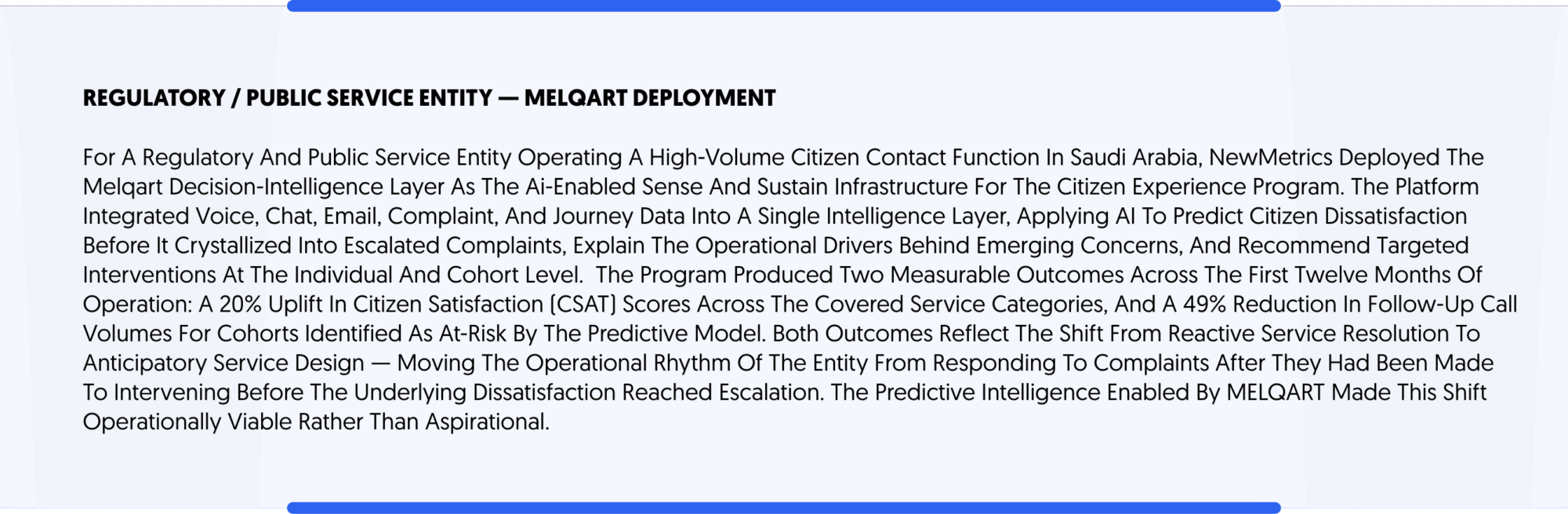
The engagement illustrates the broader pattern this article describes. AI produced measurable value at the specific point where it amplified the entity’s existing citizen experience methodology, capability, and operational discipline. The AI investment worked because the underlying system was ready to be amplified. The same investment applied without that foundation would have produced technical demonstrations rather than operational outcomes. The sequence — foundational innovation system first, AI amplification second — is what distinguished this engagement from the predictable disappointments of technology-first deployments.
MELQART: The Decision-Intelligence Layer
MELQART operates as the NewMetrics decision-intelligence platform layer that extends Medallia across the full 4S cycle. Where Medallia excels at capturing voice-of-customer and operational feedback, MELQART combines those signals with behavioral, social, speech, and journey data to produce an integrated intelligence capability that predicts risk, explains drivers, simulates impact, and recommends actions. The four capabilities together transform the innovation intelligence layer from descriptive analytics — telling the organization what happened — to predictive and prescriptive intelligence, telling the organization what will happen and what to do about it.
Predictive capability identifies specific customers, citizens, cohorts, or operational conditions likely to produce poor outcomes ahead of the outcomes themselves — enabling targeted intervention rather than reactive resolution. Explanatory capability identifies the operational, experiential, or contextual drivers behind observed patterns, converting raw performance data into decision-ready insight. Simulation capability allows innovation teams to model the likely impact of proposed changes — service redesigns, process modifications, policy updates — before committing resources to their deployment. Recommendation capability translates the intelligence into specific, prioritized actions that operational teams can execute directly, closing the gap between analysis and intervention.
The strategic value of the platform layer is in the integration across the four capabilities rather than in any one of them individually. Predictive intelligence without explanation cannot inform strategy. Explanation without simulation cannot inform intervention design. Simulation without recommendation cannot inform operational execution. MELQART operates as the integrated layer that connects all four into a single decision-intelligence architecture — deployed in service of methodology and capability rather than as a standalone platform investment. The KSA case study above illustrates the operational form the integrated capability takes in a specific engagement. The broader positioning is that MELQART operates as the intelligence layer through which the entire 4S cycle is instrumented in NewMetrics regional client deployments.

Preconditions For AI-Accelerated Innovation
AI-accelerated innovation produces sustained value when specific organizational preconditions are in place. Programs that deploy AI without these foundations consistently produce impressive individual pilots and limited institutional impact. Programs that establish the foundations first, then layer AI capability across them, produce the compounding pattern described throughout this article. The preconditions below are the ones most consistently associated with sustained AI-accelerated innovation outcomes across the NewMetrics regional portfolio, organized to distinguish the internal and external lenses through which they operate.

The preconditions are mutually reinforcing and their distinction matters operationally. Data foundations without internal governance produce AI decisions that cannot be defended in leadership review. Internal governance without external regulatory alignment satisfies internal review but fails sector compliance. Regulatory alignment without workflow integration produces compliance documentation that does not translate into operational outcomes. Capability without workflow integration produces trained teams unable to deploy their capability into decision-making that matters. Each precondition strengthens the others, and the most consequential AI investment is often the investment in the preconditions themselves rather than in the AI models or platforms that will operate on top of them.
How AI Amplifies The Full Innovation Series
The seven prior articles in this series each described a dimension of GCC innovation. AI amplifies each of those dimensions in specific, measurable ways. The table below illustrates the pattern through NewMetrics regional engagements — showing how AI operates as the intelligence layer across the entire series and how that architecture is generating measurable outcomes for GCC clients across sectors.

The pattern across the seven engagements is consistent. AI does not replace the underlying capability of each article’s domain. AI amplifies that capability, extending what it can do, the speed at which it can do it, and the scope at which it can operate. The value of AI compounds because each dimension amplifies the others: better Sense-stage intelligence produces stronger Shape-stage design produces more effective Scale-stage deployment produces richer Sustain-stage learning that feeds the next Sense cycle. Applied as an integrated intelligence layer rather than as isolated point deployments, AI transforms the innovation system from a collection of capable components into an operating architecture that generates compounding value across program cycles.
The Near-Term Roadmap: The Next 12 Months
The pace of AI development makes long horizons unreliable as planning instruments. The twelve-month roadmap below reflects what the NewMetrics regional portfolio suggests is the most effective progression from foundational readiness to autonomous innovation loops within the horizon where AI capability itself is stable enough to plan against — calibrated to the maturity and starting position of most GCC organizations rather than to any single sector.

The horizons above are not rigid, and organizations will progress through them at different rates depending on their starting maturity, sector context, and the strategic priority given to AI-accelerated innovation. What matters is the sequence — foundations before deployments, pilots before scale, integrated systems before autonomous loops — and the discipline of building for compounding value across the twelve-month horizon rather than optimizing for individual point deployments in the near term. Programs that follow this sequence consistently produce measurable outcomes at each horizon. Programs that skip stages consistently produce the reverse pattern described earlier in this article: impressive individual pilots, limited institutional impact, and progressive frustration among the teams asked to make the deployments work.
The Intelligence Layer Of GCC Transformation
The seven prior articles described the methodology, the spaces, the experience signals, the sustainability lens, the sector use cases, the capability layer, and the tool stack that together constitute the NewMetrics approach to GCC innovation. This article has described how AI amplifies each of those dimensions — operating as the intelligence layer that connects the entire innovation system into a single coherent operating architecture.
The trillion-dollar transformation environment described in the anchor article is generating unprecedented demand for innovation across every sector of the GCC economy. The Vision-era national strategies are documented, the capital is committed, and the timelines are public. What determines whether organizations convert this environment into sustained competitive advantage is the discipline with which they build the innovation system — the methodology, capability, tools, and intelligence layer that together allow innovation to move from ambition to measurable outcome. AI is the amplifier that makes this operating architecture generate compounding returns across program cycles. The organizations that recognize this early, build the foundations before pursuing amplification, and invest in the intelligence layer as strategic infrastructure rather than as technology category will define the pace of regional transformation across the next decade.
The white paper that will follow this series will describe the maturity model through which organizations can assess where their current innovation system sits, what capabilities they need to develop next, and how AI-accelerated innovation compounds across the maturity trajectory. The articles together establish the framework. The white paper operationalizes it. Together, they represent the NewMetrics view on how GCC organizations can build innovation systems that are worthy of the transformation environment they are operating within — and how AI, applied as intelligence layer rather than as innovation category, amplifies those systems into the operating architectures that will define competitive advantage across the next decade.


KEY REFERENCES
- Davenport, T. H., Guha, A., Grewal, D., & Bressgott, T. (2020). How artificial intelligence will change the future of marketing. Journal of the Academy of Marketing Science, 48(1), 24–42. https://doi.org/10.1007/s11747-019-00696-0
- Edmondson, A. C. (1999). Psychological safety and learning behavior in work teams. Administrative Science Quarterly, 44(2), 350–383. https://doi.org/10.2307/2666999
- El Hinnawi, M. (2026). Innovation labs in GCC: Bridging the public-private divide in a $trillion transformation era. NewMetrics Advisory. https://newmetrics.com/insights/innovation-labs-in-gcc-bridging-the-public-private-divide-in-a-trillion-transformation-era/
- Floridi, L., Cowls, J., Beltrametti, M., Chatila, R., Chazerand, P., Dignum, V., … & Vayena, E. (2018). AI4People — An ethical framework for a good AI society: Opportunities, risks, principles, and recommendations. Minds and Machines, 28(4), 689–707. https://doi.org/10.1007/s11023-018-9482-5
- G42. (2026). Stargate UAE: 5-gigawatt AI data center development announcement. https://www.g42.ai
- Government of Saudi Arabia. (2024). Project Transcendence: National AI and advanced technology acceleration initiative. https://www.my.gov.sa
- Government of Saudi Arabia. (2025). Saudi Vision 2030: Non-oil exports and industrial expansion progress report. https://www.vision2030.gov.sa
- Government of the United Arab Emirates. (2024). We the UAE 2031: Vision and federal strategy. https://u.ae
- Institute of Chartered Accountants in England and Wales. (2025). ICAEW Economic Insight Q4 2025: GCC outlook (produced by Oxford Economics). https://www.icaew.com
- Precedence Research. (2026). GCC artificial intelligence market: Investment, adoption, and economic transformation. https://www.precedenceresearch.com
- Saudi Data and Artificial Intelligence Authority — SDAIA. (2024). State of AI in Saudi Arabia and National Strategy for Data and AI. https://sdaia.gov.sa
- UAE AI Office. (2024). UAE Artificial Intelligence Strategy 2031: Implementation progress. https://ai.gov.ae
- World Economic Forum. (2025). The future of jobs report 2025. https://www.weforum.org/publications/the-future-of-jobs-report-2025/
- World Economic Forum. (2026). Gulf nations: Adjusting to the global economic realignment. https://www.weforum.org/stories/2026/01/gulf-investment-innovation-technology-energy/