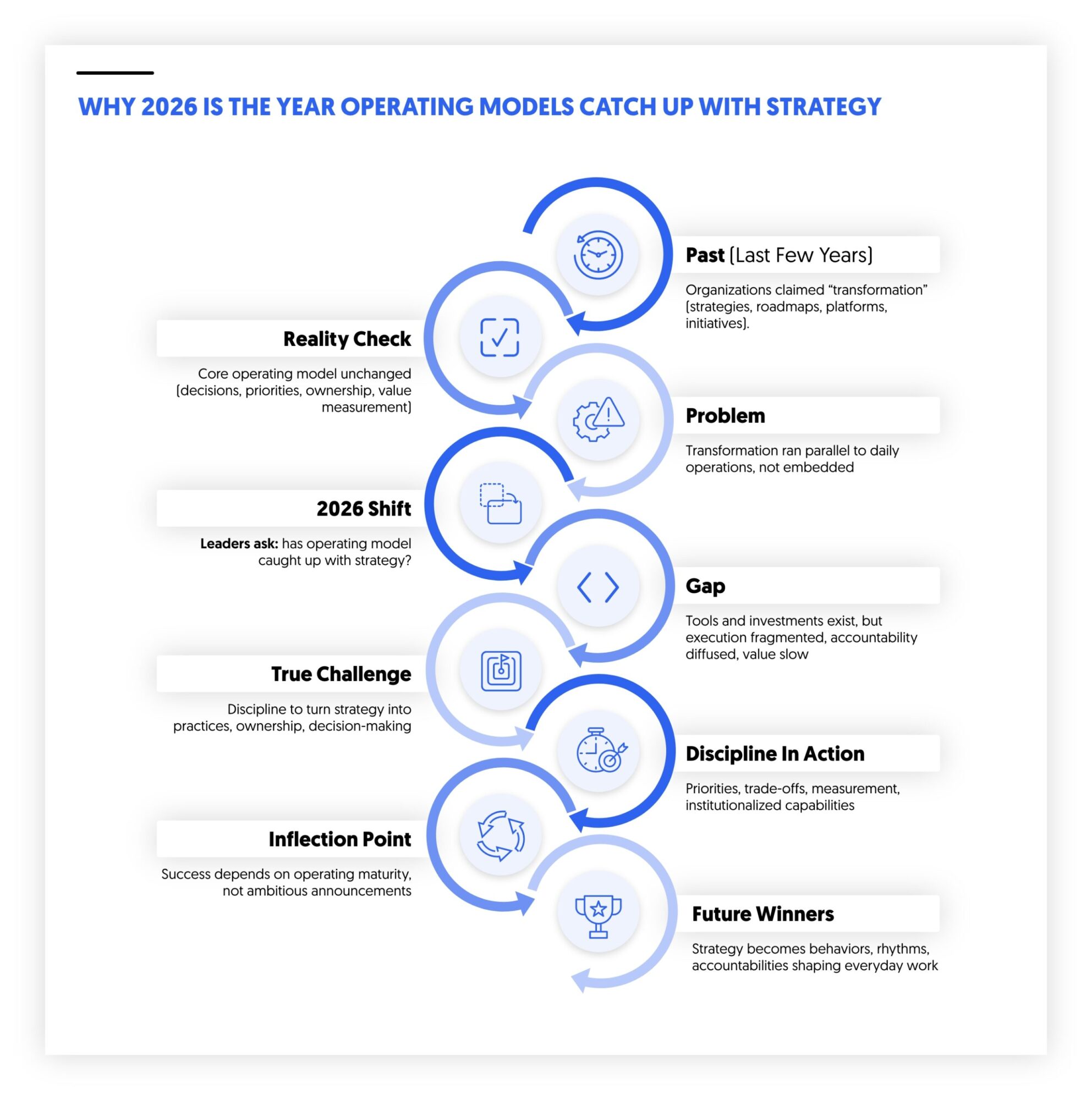
Over the past few years, many organizations described themselves as being “in transformation.” Strategies were announced, roadmaps were presented, new platforms were implemented, and a long list of initiatives signaled momentum. Yet in many cases, the core operating model how decisions are made, how work is prioritized, how capabilities are owned, and how value is measured remained largely unchanged. Transformation became something that existed in parallel to day-to-day operations rather than something embedded within them.
In 2026, that pattern is no longer sustainable. Leaders are moving beyond statements of intent and asking a more fundamental question: has the operating model actually caught up with the strategy? The answer, in many organizations, is still no. The tools exist, the investments were made, and the initiatives are visible, but execution remains fragmented, accountability is diffused, and value realization is slower than expected.
The real challenge is no longer about launching programs or acquiring technology. It is about discipline: the discipline to translate strategy into repeatable practices, clear ownership, and coherent decision-making. Discipline shows up in how priorities are set, how trade-offs are managed, how measurement drives action, and how capabilities are institutionalized rather than temporarily assembled around projects.
This shift marks an inflection point. The organizations that perform best in 2026 will not be the ones announcing the most ambitious transformations. They will be the ones that build the operating maturity to sustain them -where strategy is not a vision document, but a system of behaviors, rhythms, and accountabilities that shape everyday work.
The Strategy–Execution Gap Is No Longer a Technology Problem
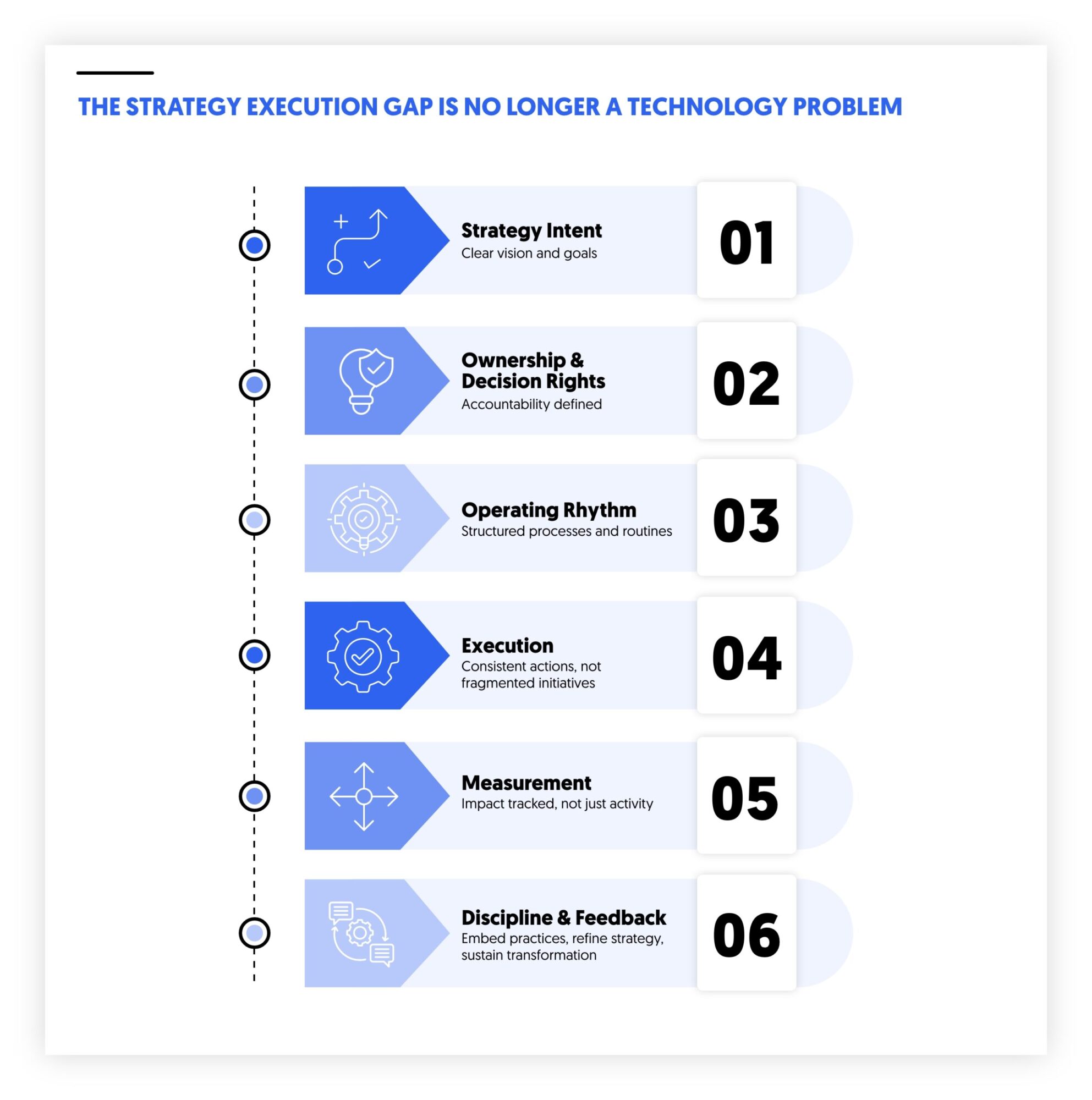
The challenge is no longer about acquiring tools or launching initiatives. Most organizations already have the technology, platforms, and data they once lacked. What they still struggle with is converting strategic intent into consistent execution. Without clear ownership, defined decision rights, and a structured operating rhythm, even the most sophisticated initiatives remain fragmented.
The consequences are familiar: priorities overlap or conflict, accountability is diffused, and progress is measured by activity rather than impact. CX programs may run alongside EX initiatives, AI pilots may operate independently of service design, and new capabilities often exist in isolation rather than as part of a coherent system. The result is not a lack of effort, but a lack of discipline the very discipline required to ensure that strategy actually shapes day-to-day decisions and behaviors.
For 2026, this distinction matters. Leaders who succeed will be those who focus less on launching new projects and more on embedding repeatable practices, clarifying accountability, and using measurement to drive action. Strategy–execution gaps are no longer technical problems to be solved by tools; they are operational problems that require intentional design, leadership rigor, and disciplined follow-through.
What Discipline Looks Like in Practice
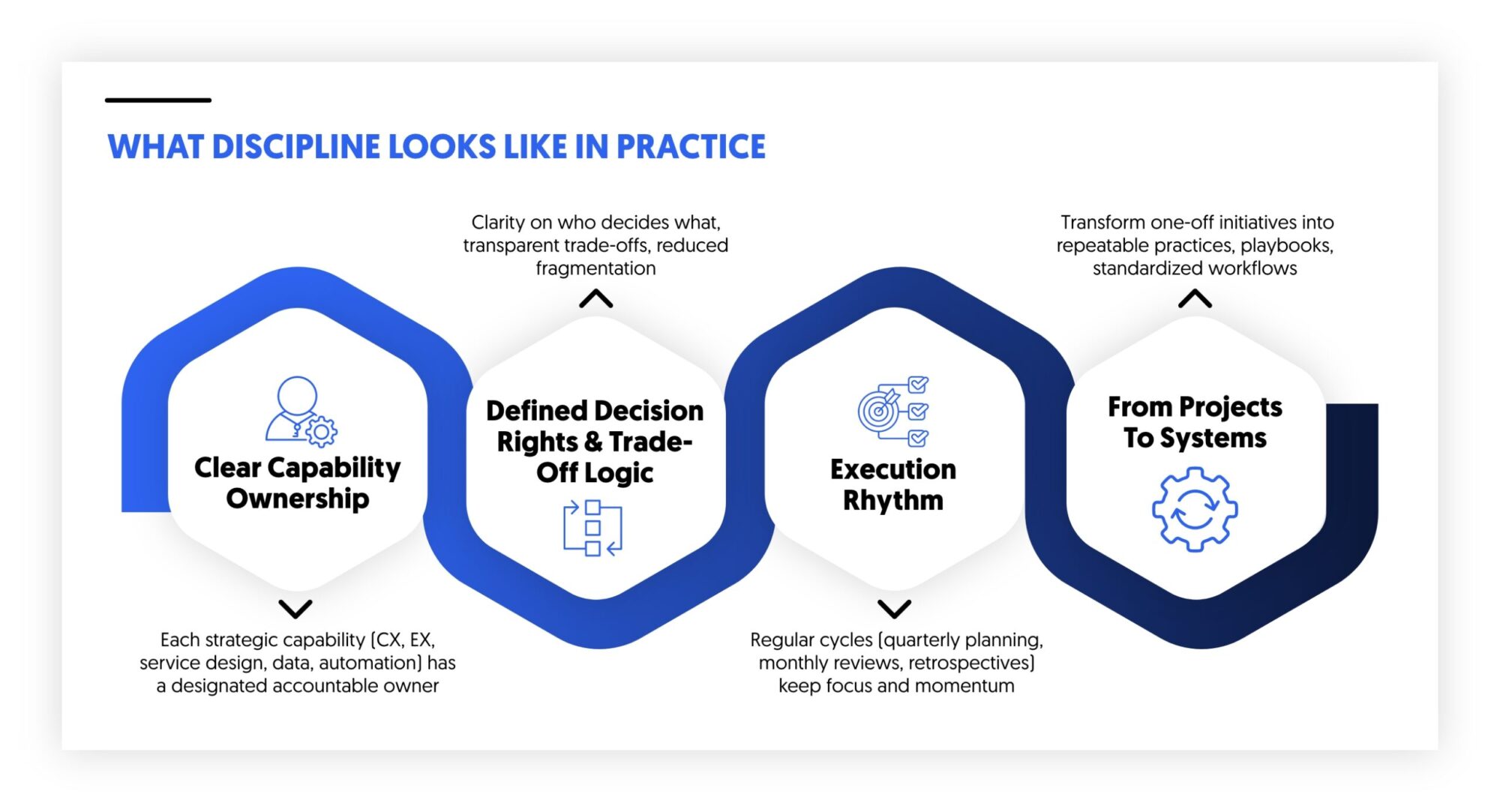
If the strategy–execution gap is the core challenge, the solution is discipline: a set of repeatable practices and structures that ensure strategy is consistently translated into decisions, behaviors, and outcomes. Discipline is not about bureaucracy; it is about clarity, accountability, and operational integrity. In practice, it manifests across four interdependent dimensions:
1. Clear Capability Ownership
Every strategic capability whether CX, EX, service design, data analytics, or automation must have a designated owner responsible for both outcomes and ongoing stewardship. Ownership is not symbolic; it is tied to resources, governance, and measurable results. When teams know who is accountable for each capability, priorities align, redundancies are reduced, and decision-making becomes faster and more reliable.
2. Defined Decision Rights and Trade-Off Logic
Discipline requires clarity on who decides what, and on what basis. Organizations often waste time in endless committees or unclear escalation paths. By defining decision rights, leaders ensure that trade-offs between competing initiatives are explicit, transparent, and systematically managed. This prevents strategic fragmentation and allows teams to act confidently within their scope of authority.
3. Execution Rhythm
Strategic alignment cannot be achieved through ad-hoc activity. Organizations that operate with a regular execution rhythm-quarterly planning cycles, monthly review meetings, and structured retrospectives-maintain focus and momentum. Measurement becomes actionable, enabling teams to adjust course in real time rather than discovering gaps only after projects are complete.
4. From Projects to Systems
One-off initiatives create temporary bursts of activity, but do not embed strategic capabilities into daily operations. Discipline transforms projects into systems: repeatable practices, playbooks, and standardized workflows that persist beyond the initial launch. By institutionalizing processes, organizations ensure that gains are durable, scalable, and replicable across units.
Where Organizations Get Stuck and Why
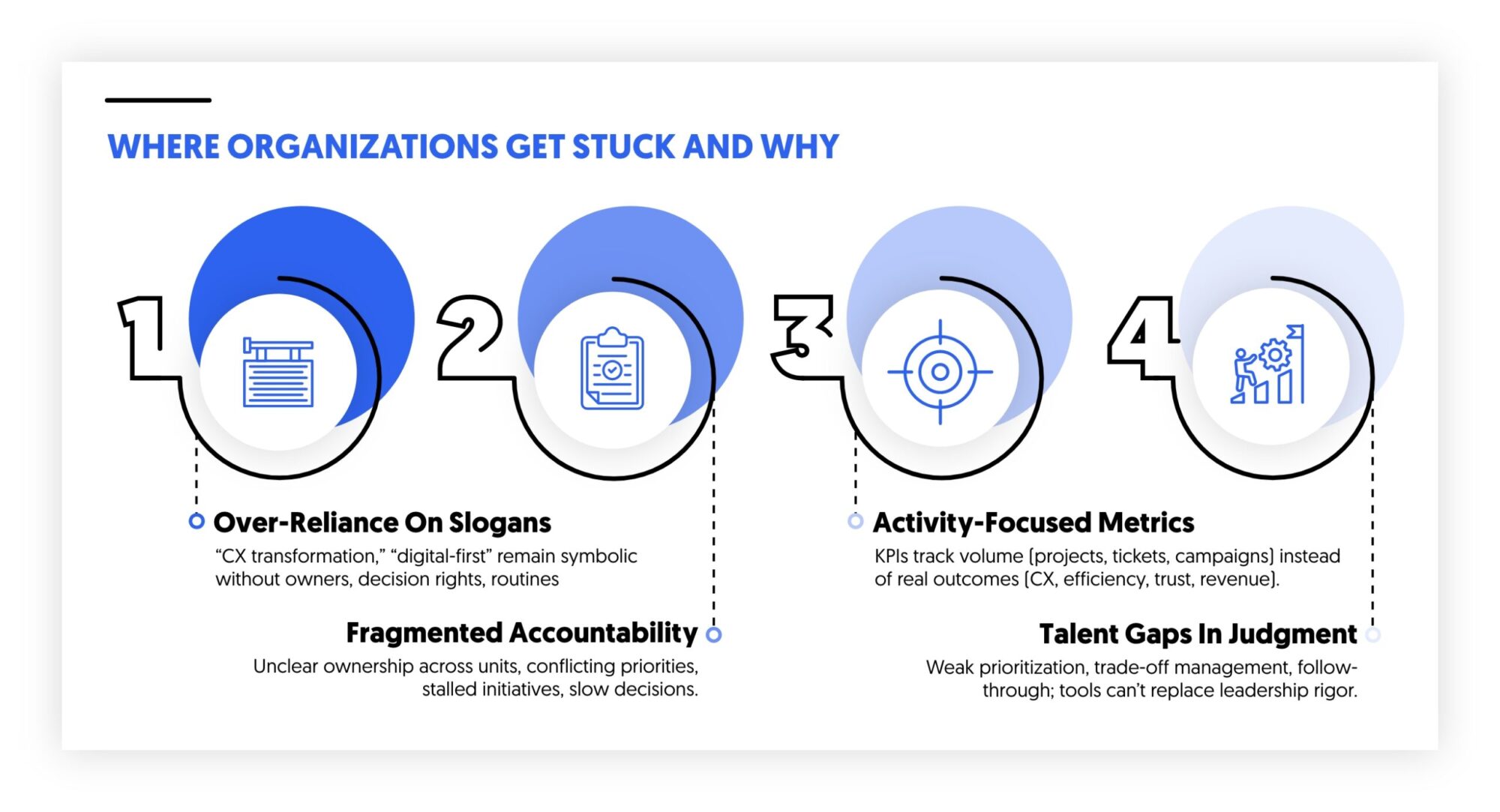
Even when organizations recognize the importance of discipline, many struggle to embed it effectively. The barriers are rarely technical; they are structural, cultural, and behavioral. Understanding these pitfalls is critical to closing the strategy–execution gap.
1. Over-Reliance on Transformation Slogans
Announcements of “CX transformation” or “digital-first strategy” often create the illusion of progress. Without translating these slogans into operational mechanisms clear owners, decision rights, and execution routines initiatives remain symbolic rather than impactful. Teams may feel busy, dashboards may be filled with activity metrics, but measurable outcomes remain elusive.
2. Fragmented Accountability Across Units
Capabilities often span multiple departments, but ownership is rarely clearly assigned. When accountability is diffused, conflicting priorities emerge, initiatives stall, and teams defer decisions to committees or leadership, slowing momentum. Discipline requires that accountability is explicit and aligned with both authority and resources.
3. Metrics That Reward Activity, Not Value
Many organizations track volume-based KPIs-number of projects launched, tickets closed, or campaigns executed -instead of measuring the outcomes that truly matter: customer satisfaction, operational efficiency, trust, or revenue impact. This creates incentives for doing work rather than achieving results.
4. Talent Gaps in Judgment and Stewardship
Even with capable teams, leadership gaps in prioritization, trade-off management, and follow-through undermine discipline. Tools and processes cannot replace the judgment required to sustain execution and reinforce behaviors that translate strategy into consistent results.
5. Culture That Rewards Launching Over Sustaining
Organizations often celebrate the initiation of projects while overlooking the ongoing effort required to institutionalize capabilities. Without a culture that values persistence, learning, and course correction, even well-designed operating models fail to deliver long-term impact.
These failure patterns highlight that 2026 is not about new initiatives or technology adoption. It is about embedding repeatable structures, accountable leadership, and a culture of disciplined execution. Recognizing these constraints provides a clear roadmap: focus on operating model maturity, measure the right outcomes, and build the behaviors that sustain strategic priorities.
The 2026 Operating Model Priorities
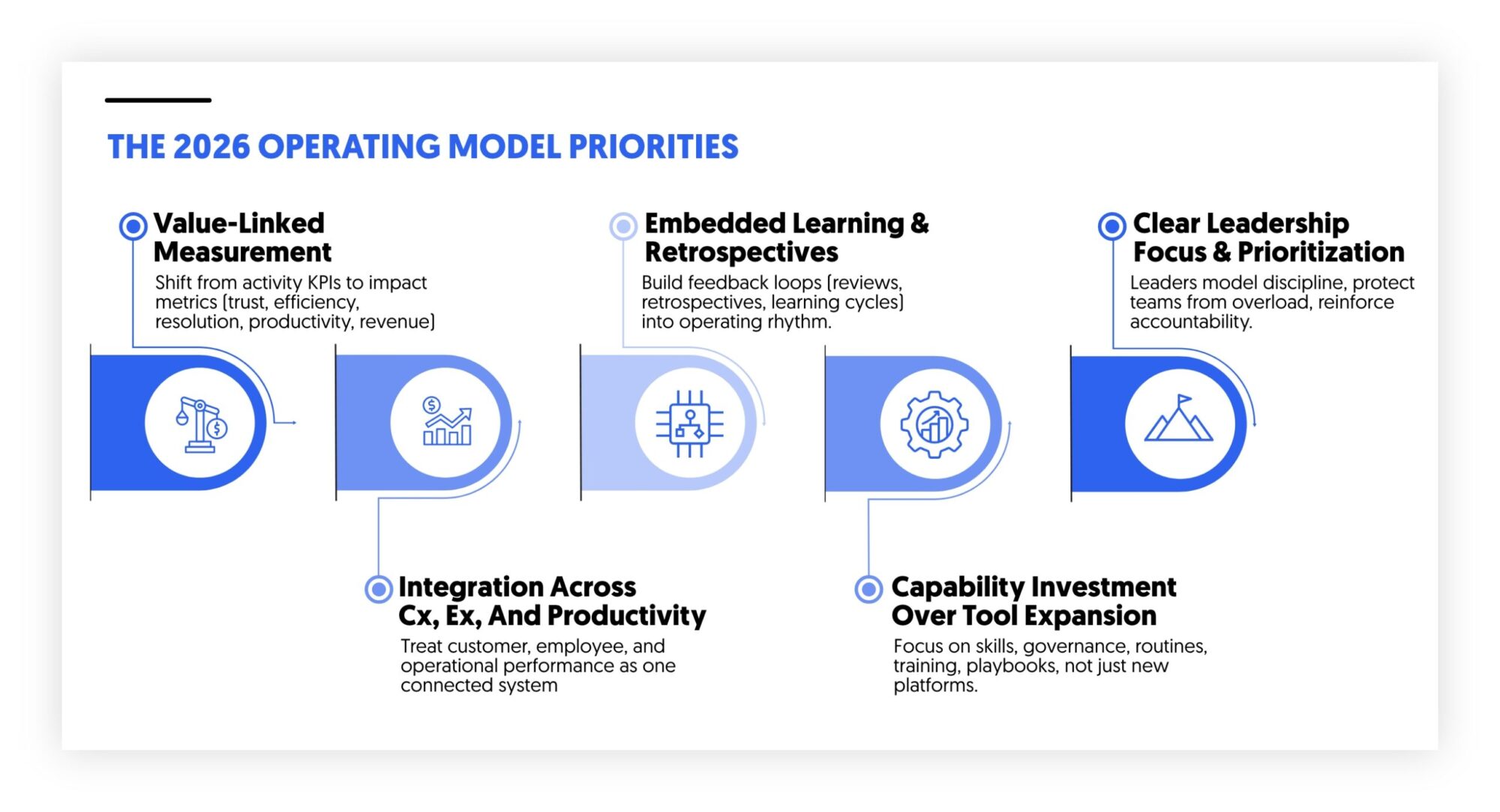
Having established where organizations get stuck, the next step is to define the priorities that will enable discipline to take hold in 2026. Success depends on moving from fragmented initiatives to a cohesive operating model that links strategy, capabilities, and outcomes.
1. Value-Linked Measurement
Organizations must shift from activity-based KPIs to impact-focused metrics. Instead of tracking the number of projects launched, teams should measure the outcomes that matter: customer trust, service efficiency, resolution times, employee productivity, and revenue impact. Value-linked measurement ensures that data informs decisions and drives accountability, rather than serving as a passive reporting tool.
2. Integration Across CX, EX, and Productivity
Customer experience, employee experience, and operational performance are interdependent levers. High-performing organizations treat them as a connected system, where improvements in one area reinforce gains in others. For example, reducing friction in service delivery not only increases customer satisfaction but also frees employees to focus on higher-value tasks. This holistic perspective ensures initiatives reinforce rather than compete with each other.
3. Embedded Learning and Retrospectives
Discipline requires systematic feedback loops. Regular retrospectives, after-action reviews, and learning cycles should be built into the operating rhythm. These mechanisms allow teams to course-correct quickly, reinforce what works, and retire initiatives that fail to deliver value. Over time, this creates an organization capable of continuous improvement without reinventing the wheel.
4. Capability Investment Over Tool Expansion
While tools and platforms are important, they are not the differentiator. The real competitive edge comes from investing in skills, governance structures, and operating routines that make initiatives sustainable. Training, role clarity, accountability mechanisms, and playbooks ensure that capabilities persist beyond individual projects or temporary teams.
5. Clear Leadership Focus and Prioritization
Finally, leaders must allocate their time and attention to the few decisions that truly move the needle. Discipline is reinforced when leadership consistently models prioritization, follow-through, and consequence management. This includes protecting teams from initiative overload, ensuring decision rights are respected, and publicly reinforcing behaviors that sustain strategic execution.
What Leaders Need to Do Differently
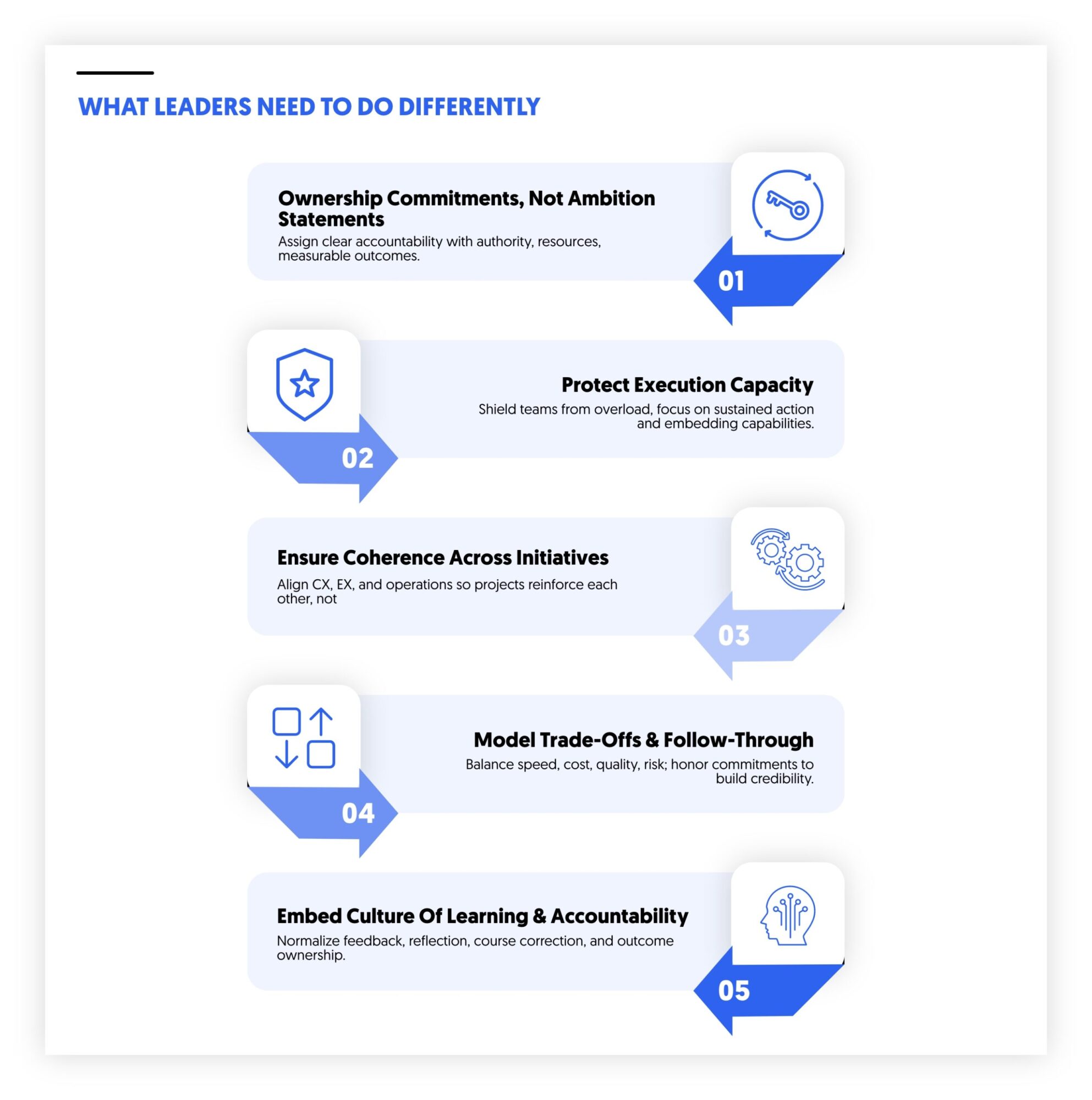
Implementing disciplined operating models requires intentional leadership behaviors that reinforce accountability, clarity, and value-driven execution. Leaders set the tone for how strategy becomes operational reality, and in 2026, their role must evolve beyond sponsorship into active stewardship.
1. Replace Ambition Statements with Ownership Commitments
Announcing a transformation is not enough. Leaders must assign clear accountability for every strategic capability, ensuring that ownership comes with authority, resources, and measurable outcomes. This shift moves the organization from symbolic declarations to tangible commitments that teams can act on with confidence.
2. Protect Capacity for Execution, Not Just Ideation
Leaders often prioritize launching new initiatives over sustaining existing ones. Discipline requires shielding teams from overextension, allowing them to focus on execution, continuous improvement, and embedding capabilities. It is through sustained action ,not just ideation, that strategy takes hold.
3. Prioritize Coherence Across Initiatives
High-performing leaders actively manage the interactions between initiatives. CX, EX, and operational projects should not compete for attention or resources; leaders must ensure that initiatives reinforce each other, align with strategic goals, and avoid duplication. This coherence accelerates impact and prevents wasted effort.
4. Model Trade-Offs and Follow-Through
Every organization faces competing priorities. Leaders who demonstrate disciplined trade-off decisions balancing speed, cost, quality, and risk signal to teams how to act within constraints. Equally important is consistent follow-through: commitments that are not honored erode credibility and reinforce fragmented execution.
5. Embed a Culture of Learning and Accountability
Discipline flourishes in environments where feedback, reflection, and corrective action are normalized. Leaders must encourage structured learning loops, reward course corrections, and hold individuals accountable for outcomes rather than activity alone. This creates a self-reinforcing cycle of improvement and operational rigor.
Discipline as the New Competitive Advantage
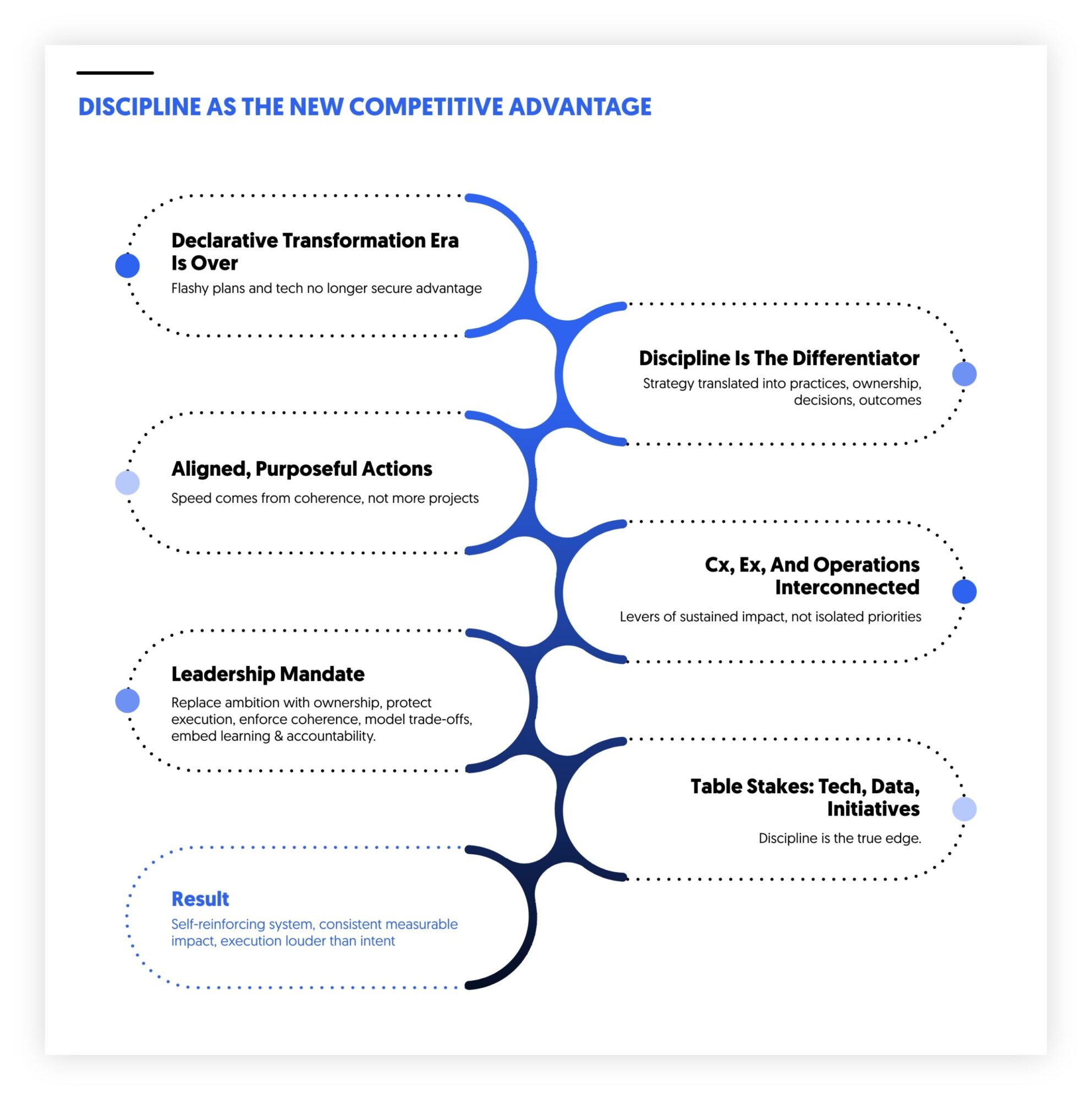
As organizations enter 2026, the era of declarative transformation is over. Ambitious plans, flashy initiatives, and new technologies are no longer enough to secure competitive advantage. The differentiator is discipline: the ability to translate strategy into repeatable practices, accountable ownership, coherent decisions, and measurable outcomes.
Organizations that embed discipline into their operating models will move faster, not because they launch more projects, but because every action is aligned, purposeful, and value-driven. Customer experience, employee experience, and operational performance will no longer be isolated priorities; they will function as interconnected levers of sustained impact.
For leaders, the mandate is clear: replace ambition with ownership, protect execution capacity, enforce coherence across initiatives, model trade-offs, and cultivate a culture of learning and accountability. These are not optional behaviors; they are the foundation of operational integrity and strategic success.
When technology, data, and initiatives are table stakes, discipline becomes the ultimate competitive advantage. The organizations that master it will not only deliver on their strategic promises but will create a self-reinforcing system capable of consistent, measurable, and lasting impact. In 2026, execution will speak louder than intent and disciplined organizations will be the ones that truly lead.